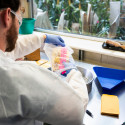
Tracking bacteria evolution
Figuring out how unfriendly bacteria prepare themselves and future generations for life outside the friendly environment of their hosts could have a direct impact on public health.
“It’s a question of life and death,” says Dorte Dopfer, a UW–Madison veterinary epidemiologist and specialist in the food-borne bugaboo Escherichia coli O157:H7. “Ten of those bacteria can kill a person, especially young children and the elderly.”
Dopfer and UW–Madison bacteriologist Charles Kaspar will study the evolutionary ecology of infectious pathogens by separating their life and reproduction cycles inside and outside hosts and examining the trade-offs an organism may have to make to increase its chances of survival in one environment or the other.
Teamed with Texas A&M University epidemiologist and computer modeler Renata Ivanek-Miojevic, the researchers will take an interdisciplinary tack with a $1 million National Science Foundation grant that provides for the addition of cutting-edge DNA analysis equipment to Dopfer’s lab.
Tags: federal relations
-
UW–Madison’s reach throughout Wisconsin adds up to $38.9 billion a year
The university supports more than 287,000 jobs and helps drive private-sector growth.
-
‘Being part of something bigger than you’ with Badger Volunteers
UW–Madison students head into the local community to find purpose and make a difference.
-
UW–Madison again named a ‘new Ivy’ by Forbes
The university was selected as one of the best in the country at "preparing and graduating the talent" that meets today's workforce needs.
-
UW–Madison graduate programs ranked among the nation’s best by U.S. News
Nearly 20 programs ranked in their respective Top 10 lists, shining a light on the breadth and depth of the university’s graduate offerings.